

Who this is for: travellers planning a flight or long drive of 4 to 6 hours or more, and anyone with varicose veins, leg swelling or a past clot who wants to travel more comfortably.
On this page
The short answer
- Pulse recommends light, below-knee graduated compression for most travellers, worn for the whole journey.
- Our compression FAQ notes they are most useful on flights longer than 4 to 6 hours.
- Measure your ankle and calf in the morning, then choose the size from the brand's chart.
- If you have had a clot, recent surgery or other risk factors, talk to your doctor or a Pulse nurse before you fly.
Why people wear compression stockings when flying
On a long flight you sit for hours with little leg room, and the dry cabin air and changes in pressure all slow blood flow in the legs. Our compression uses page explains that graduated compression applies the most pressure at the ankle and less further up the leg, which helps blood return towards the heart and limits fluid collecting around the ankles.
That is why many travellers notice less ankle swelling and less heaviness when they land. Our FAQ also says compression is commonly used to help lower the risk of travel-related clots, especially on flights longer than 4 to 6 hours. It does not remove that risk, so the other habits below still matter.
Who benefits most from travel compression
Pulse lists these groups as getting the most out of compression on long journeys by plane, car, train or bus:
- Trips longer than 4 to 6 hours
- Tall passengers, or anyone who cannot move around much in their seat
- Pregnancy or travel soon after having a baby
- People with varicose veins or leg swelling
- People who have had a DVT or have clot risk factors, recent surgery or illness
- Older travellers, and people with heart failure, obesity, or taking oral contraception or hormone replacement
Had a clot before, or recent surgery? Talk to your doctor or the Pulse nursing team before you book a long flight. Stockings can be part of a travel plan, but the plan should be made with someone who knows your history.
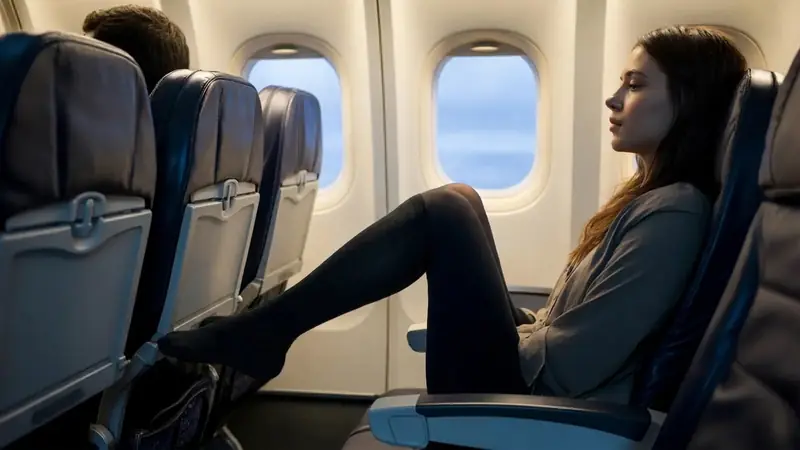
Compression socks for travel: what to look for
Travel socks are usually light compression, below the knee, and look much like an ordinary sock. Pulse stocks German and Swiss brands and recommends below-knee graduated stockings for most people, with the lightest medical level (level or class 1) suiting most travellers.
| Product | Style | Good to know |
|---|---|---|
| medi travel (women) | Below knee, closed toe, class 1 | Semi-transparent finish that looks like everyday hosiery |
| medi travel (men) | Below knee, closed toe, class 1 | Ribbed sock look, worn with any shoe |
| mediven for men | Below knee, class 1 | A business-sock look for people who travel for work |
| Venosan 6001 | Below knee, class 1 | Supplied with a veno-glider to help put them on |
Rubber gloves and stocking aids make socks much easier to pull on in a small space, and medi fix skin glue helps stop thigh-length styles slipping. All of these are in the compression section of the shop.
Compression socks for flying in NZ: buying online or with a fitting
If you know your measurements and have no leg problems, you can order travel socks online. If you have varicose veins, swelling that does not go down overnight, or one leg larger than the other, a nurse fitting is the safer route because the right strength and length may be different.
Not sure which size or strength to buy before your trip? A Pulse nurse can help.
Ask a nurseHow to size flight socks
- Measure in the morning, when swelling is lowest. If you measure later in the day, rest with your legs raised for 10 to 15 minutes first.
- Measure bare skin with a soft tape in centimetres, snug but not tight.
- Ankle: the narrowest point just above the ankle bone.
- Calf: the widest part of the calf, keeping the tape level.
- Length (below knee): from the floor to 2 to 3 cm below the crease behind the knee.
These are the steps Pulse's nurses use and publish in the size and measure guide. If your measurements sit between two sizes, or one leg is noticeably bigger than the other, ask for a fitting rather than guessing.
Choose your size from the brand's own chart using the ankle and calf figures, not your shoe size alone. Socks that are too tight can dig in behind the knee; socks that are too loose give little support.
How to wear compression stockings on a flight
- Put them on before you leave home, when your legs are least swollen, and keep them on for the whole journey.
- Turn the sock inside out to the heel, place your foot in, then roll it up gradually. Do not pull from the top.
- Walk the aisle when you can, do calf exercises in your seat, drink water, and avoid tight clothing at the groin, as Pulse's travel advice recommends.
- Take them off at night once you arrive, and wash them gently.
Signs your socks do not fit
- They should feel firm but comfortable, and should not cause pain, numbness or tingling.
- They should sit smoothly without wrinkles and stay up without rolling or digging in.
- Take them off and get advice if you notice toe discolouration or coldness, deep marks, pinching, rolling, or pain or swelling that gets worse.
Know the warning signs after travel. Pulse notes that a DVT can appear a few days or even weeks after a trip. Calf pain, swelling, warmth or skin colour change in one leg needs urgent medical review. Chest pain or sudden breathlessness needs emergency care: call 111.
Travel socks vs medical compression stockings
Travel socks and medical stockings work the same way. The difference is how firm they are and who chooses them. Pulse stocks three compression levels and recommends level 1 for most people.
| Travel socks (class 1) | Medical stockings (class 2 and above) | |
|---|---|---|
| Typical use | Long flights and drives, tired or mildly swollen legs | Varicose veins, ongoing swelling, after vein treatment or a clot |
| Who chooses | Most travellers can buy online using the size chart | Best chosen at a nurse fitting, or on your clinician's advice |
| Length | Below knee | Below knee, thigh high or tights, depending on the need |
| At Pulse | medi travel, mediven for men, Venosan 6001 | mediven elegance (class 2 on request), custom and flat-knit garments through a fitting |
More detail on the classes is in our guide to medical compression stockings.
Where to buy flight socks in NZ
The Pulse shop ships New Zealand wide, including rural addresses, for a $10.50 flat rate, with free shipping on product totals over $150. Healthify NZ notes that flight socks can also be bought from pharmacies, where the pharmacist can advise on the right type. If you have vein problems or a past clot, a nurse fitting is the safer choice.
Flight socks NZ: when to see a nurse first
Most travellers can buy light compression and go. Book a free phone chat with a Pulse nurse, or a nurse consultation, if any of these apply:
- You have varicose veins, ongoing swelling or skin changes on your lower legs.
- You have had a blood clot, or recent surgery.
- You have peripheral arterial disease, neuropathy, or unexplained leg pain or swelling. Our FAQ says these need medical advice before using compression.
- You are pregnant. Maternity designs and regular re-measuring may be needed: see our maternity compression guide.
Pulse's nurses can measure you, suggest a style and level, and explain what else to do on the day. More on the clot side of travel is on our compression stockings for DVT page and our blood clots page.
Frequently asked questions
Do I need compression socks for a short flight?
Our compression FAQ says they are most useful on flights longer than 4 to 6 hours. Some people still like them on shorter trips for comfort.
What strength of flight socks should I buy?
Pulse recommends the lightest medical level (class 1) below-knee compression for most travellers. If you have vein problems or a past clot, get advice on strength first.
Can I wear flight socks overnight on a long-haul flight?
Pulse's general advice is to wear compression during the day and take it off at night unless you have been told otherwise. On an overnight flight, ask your nurse or doctor what suits you.
Are travel socks the same as hospital TED stockings?
No. Healthify NZ explains that TED stockings are designed for people lying down, such as after surgery, while graduated compression stockings are for people who are up and walking.
Do compression socks stop DVT on flights?
They are one way to reduce the risk, alongside moving, calf exercises and drinking water, but they do not remove it. Anyone with clot risk factors should get advice before travelling.
How long do travel compression socks last?
Pulse says most stockings last up to about 6 months of regular use before they lose their stretch and need replacing.
Order travel compression online, or talk to a nurse if you have veins, swelling or a past clot.
Shop the rangeAbout this guide
Our specialist vascular nurses measure and fit medical-grade compression, and our shop stocks the medi travel stockings for men and women shown on this page. This guide puts our nurses' travel advice in one place, alongside Healthify NZ's information on compression stockings. Last reviewed 16 November 2026. If you spot anything out of date, email info@pulsehealth.nz and we will correct it.