

Who this is for: people buying compression for varicose veins, swelling, lymphoedema or after a procedure, and anyone deciding between class 1 and class 2 or between ready-made and custom stockings.
On this page
The short answer
- Medical compression stockings apply graduated pressure, highest at the ankle, with a set strength or class.
- Pulse stocks three levels and recommends level 1 for most people; class 2 is for varicose veins and swelling.
- Lymphoedema and lipoedema often need flat-knit or custom-made garments.
- A nurse measurement and fitting is the surest way to the right class, size and length.
What makes compression stockings medical grade
Our compression pages describe graduated compression stockings as garments with a built-in pressure gradient, strongest at the ankle and reducing up the leg. That gradient helps venous blood and tissue fluid move out of the legs and back towards the heart, and stops blood and fluid pooling at the ankles.
Pulse stocks German and Swiss brands because of their quality and durability, and its specialist nurses measure and fit stockings so the strength and size suit the condition. Pulse's uses include varicose veins, aching and heavy legs, oedema, venous eczema, superficial vein thrombosis, venous leg ulcers, after DVT or vein procedures, and travel.
Compression manages symptoms and reduces complications. Pulse is clear that it does not cure varicose veins: definitive treatments are needed to correct the underlying vein problem.
What New Zealand health guidance says
Healthify NZ, New Zealand's public health information site, describes the same two main types: graduated compression stockings for people with poor blood flow who can walk around, and TED (anti-embolism) stockings designed for people lying down, such as after surgery. It also says compression stockings are not suitable if you have suspected or proven peripheral arterial disease or an allergy to the stocking material, recommends putting them on first thing in the morning, washing them at least every 3 days, and replacing them when they lose their stretch or are damaged.
Class 1 vs class 2 compression stockings
Pulse uses three compression levels: level 1 (lowest), level 2 (midway) and level 3 (highest), and recommends level 1 for most people.
| Level | Typical uses | How to choose |
|---|---|---|
| Class 1 (light) | Aching legs, early vein symptoms, travel, standing jobs, mild swelling, pregnancy | Most people can start here |
| Class 2 (moderate) | Varicose veins, mild to moderate swelling | Best chosen at a nurse fitting |
| Class 3 (firm) | Advanced vein disease, post-procedure care, lymphoedema | On clinical advice only |
The exact pressure for each class differs between manufacturers and national standards, so compare products within one brand's chart and ask for advice before stepping up a class.
Not sure if you need class 1 or class 2? Book a nurse measurement and fitting.
Book a fittingCompression stockings for lymphoedema and lipoedema
Lymphoedema is long-term swelling caused by poor lymphatic drainage, which can be present from birth or follow surgery, cancer treatment, infection or injury. Pulse describes moderate to firm compression as suitable for most people with lymphoedema, and notes that custom-made stockings are often needed to fit the leg's shape.
Lipoedema is a long-term fat distribution disorder, almost always in women, causing symmetrical leg enlargement, pain and easy bruising. Mild to moderate compression is usually suitable.
Circular-knit vs flat-knit
- Circular-knit: thinner, smoother and easier to put on. Generally used for mild to moderate compression.
- Flat-knit: thicker and firmer, less likely to dig in or roll. Used for firm compression in lymphoedema, lipoedema and severe oedema.
Mediven compression stockings and other brands at Pulse
| Product | Style | Notes |
|---|---|---|
| mediven elegance | Women's, below knee | Class 1, with class 2 available on request |
| mediven plus | Open toe | Class 1 |
| mediven for men | Below knee | Class 1, everyday sock look |
| medi travel | Below knee, closed toe | Class 1, men's ribbed and women's semi-transparent |
| Venosan 6001 | Below knee | Class 1, with a veno-glider; around 6 months of daily wear |
Accessories help too: medi rubber gloves for grip, and medi fix skin glue to keep thigh-length styles up. Shop the compression range.
Lengths and styles
Styles range from below-knee and thigh-high to tights and pantyhose, in open or closed toe. Pulse recommends below-knee graduated stockings for most people, with thigh-high options for post-surgery needs. There are also maternity designs with an expandable panel, and pelvic and vulval designs with groin support (see our guides to maternity compression and vulvar varicose veins).
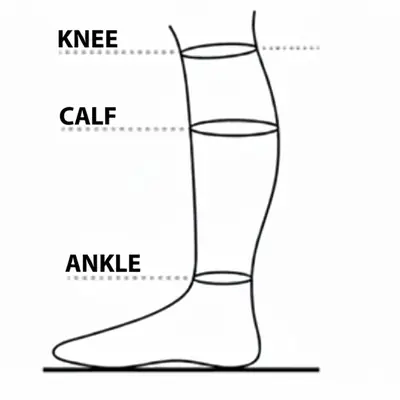
How Pulse nurses measure for medical stockings
- Measure in the morning, when swelling is lowest. If you measure later in the day, rest with your legs raised for 10 to 15 minutes first.
- Measure bare skin with a soft tape in centimetres, snug but not tight.
- Ankle: the narrowest point just above the ankle bone.
- Calf: the widest part of the calf, keeping the tape level.
- Length (below knee): from the floor to 2 to 3 cm below the crease behind the knee.
These are the steps Pulse's nurses use and publish in the size and measure guide. If your measurements sit between two sizes, or one leg is noticeably bigger than the other, ask for a fitting rather than guessing.
For thigh-high stockings, the length is measured from the floor to the upper thigh. For tights, measure from floor to waist and around the hips.
Fit and care
- They should feel firm but comfortable, and should not cause pain, numbness or tingling.
- They should sit smoothly without wrinkles and stay up without rolling or digging in.
- Take them off and get advice if you notice toe discolouration or coldness, deep marks, pinching, rolling, or pain or swelling that gets worse.
Wash on a gentle cycle and air dry away from heat. Replace stockings about every 6 months, when they lose their stretch.
Frequently asked questions
What is the difference between class 1 and class 2 compression?
Class 2 applies firmer pressure than class 1. Pulse recommends class 1 for most people and uses class 2 for varicose veins and swelling, best chosen at a fitting.
Do I need a prescription for medical compression stockings?
You can buy class 1 stockings from the Pulse shop. A nurse fitting is recommended for firmer classes or if you have a medical condition.
Can medical compression stockings cure varicose veins?
No. Our FAQ says they manage symptoms and reduce complications but do not repair faulty valves.
What compression is used for lymphoedema?
Pulse describes moderate to firm compression for most people with lymphoedema, often flat-knit or custom-made.
Are medical compression stockings latex free?
Pulse says most are latex-free. Tell the nurse fitting you if you have a latex allergy.
How long do medical compression stockings last?
Pulse says most last up to about 6 months of regular use.
Order class 1 stockings online or book a nurse fitting for firmer or custom compression.
Book a fittingAbout this guide
Pulse is a specialist vein clinic whose vascular nurses fit medical-grade compression, and our shop stocks the mediven and Venosan stockings described here. This guide explains the classes and styles the way our nurses explain them in clinic. Last reviewed 16 November 2026. If you spot anything out of date, email info@pulsehealth.nz and we will correct it.